
Singapore's EC Market Just Changed Forever — What Buyers Need to Know
Summary
Singapore's Ministry of National Development just announced the most significant overhaul of the Executive Condominium scheme since it was introduced in 1995. Three sweeping changes took effect on May 8, 2026, applying to all new EC Government Land Sales sites with tender closing dates from today onwards. If you were planning to buy an EC — or already own one — here is what you need to understand.
Change 1 — The MOP Just Doubled
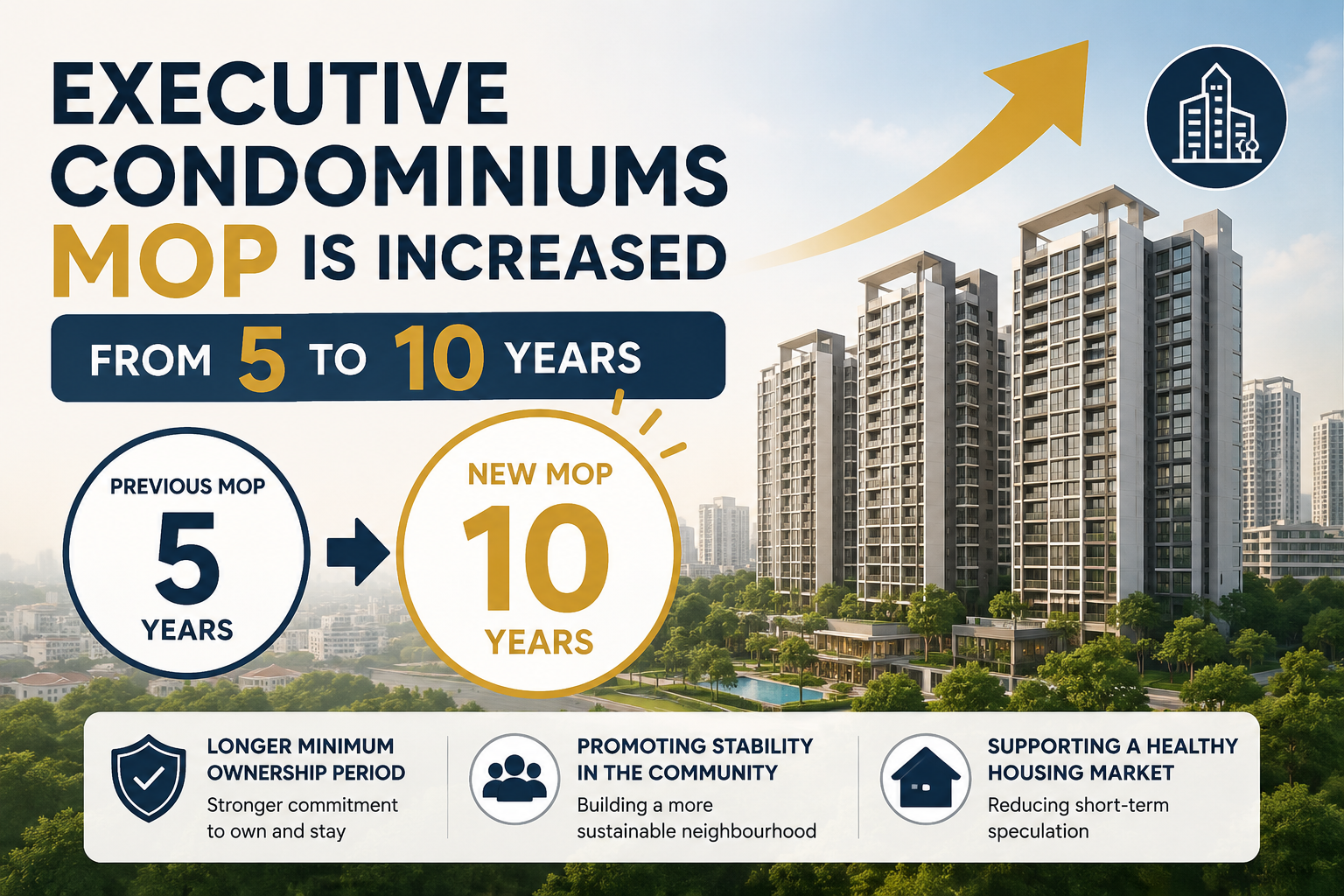
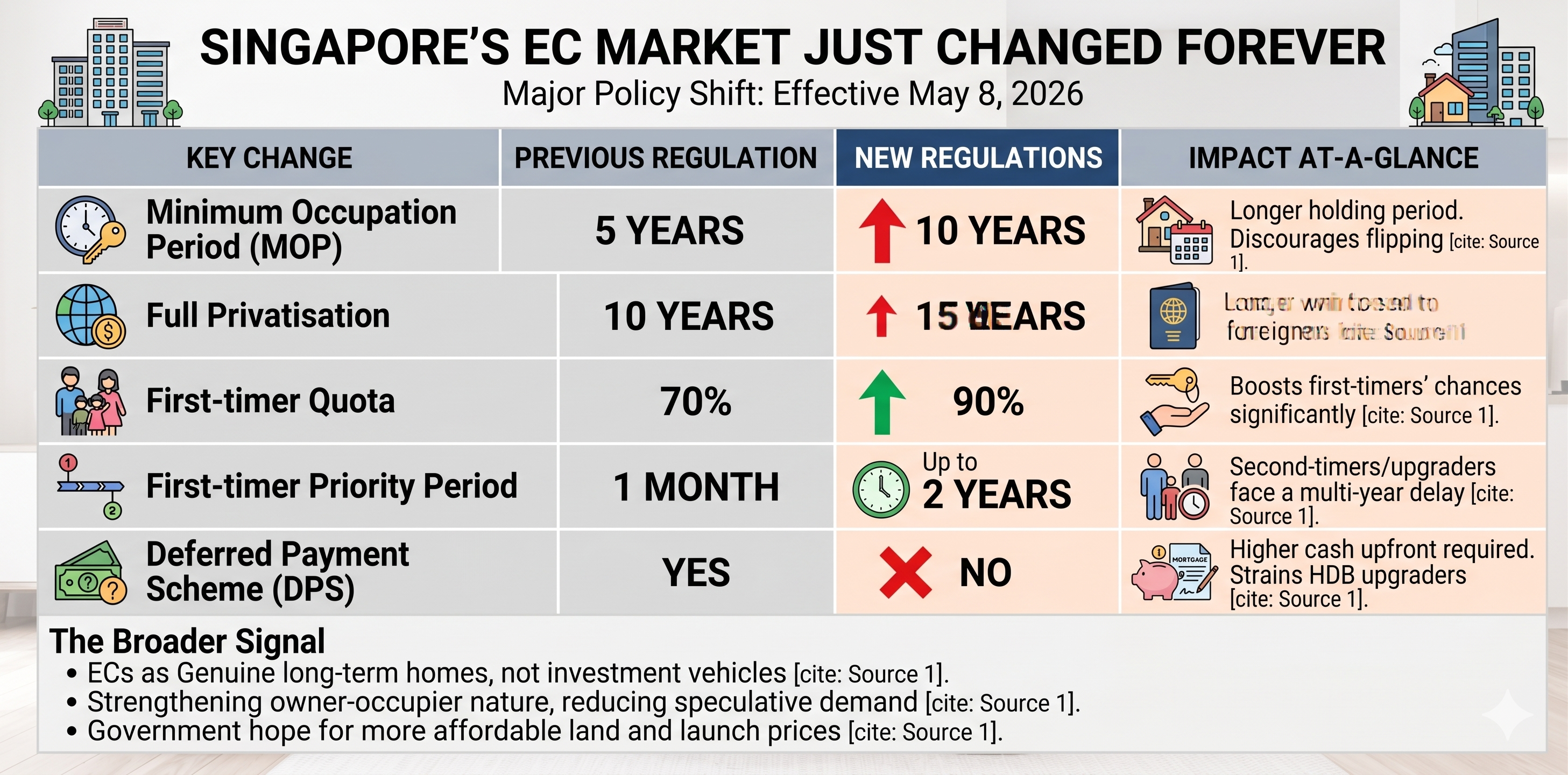
The EC Minimum Occupation Period has been extended from five years to 10 years. EC owners will now need to hold their units for a full decade before they can sell on the open market to Singaporeans and Permanent Residents. Full privatisation — when units can be sold to any buyer including foreigners — will only happen after 15 years, up from the current 10.
For buyers who planned to purchase an EC and flip it after the five-year MOP, this changes the calculus entirely. From 2021 to 2025, about 75 per cent of ECs transacted on the open market were sold within five years of their MOP — up from 45 per cent in the preceding five-year period. That pattern is now effectively impossible for new buyers.
The silver lining: genuine owner-occupiers who plan to live in their home for the long term are largely unaffected. If anything, the longer holding period could translate into stronger capital appreciation at the 10-year mark, as supply of resale EC units tightens.
What this means for the data: Expect resale EC transaction volumes to drop significantly over the next decade as the pipeline of MOP-eligible units slows. Prices for existing ECs that have already cleared their five-year MOP — and are therefore unaffected by the new rules — could see renewed interest.
Change 2 — First-Timers Get Priority for Two Years
The first-timer quota has been raised from 70% to 90%, and the priority period has been extended from one month to two full years before open booking begins.
This is a direct response to a troubling trend. The proportion of first-time EC buyers dropped from around 50 per cent in 2020 to between 30 and 40 per cent in 2024 and 2025. Second-time buyers — typically HDB upgraders flush with cash from selling their flats — had been crowding out first-timers who simply could not compete financially.
Under the new rules, second-time buyers will effectively have to wait up to two years before they even get a shot at the remaining 10% of units during launch. In practice, most will likely wait until closer to TOP, which could be years away.
What this means for the data: New EC launches will be dominated by first-timer demand during the critical initial sales window. Expect ballot rates among first-timers to rise sharply for popular projects, and second-timer demand to shift toward the resale market or private condominiums.
Change 3 — The Deferred Payment Scheme is Gone
The Deferred Payment Scheme (DPS) has been removed for EC purchases. Previously, DPS allowed buyers to defer a substantial portion of their payment until TOP, making it easier to manage cash flow — particularly for second-time buyers who still owned another property.
Around 60 per cent of EC financing currently uses DPS, particularly among second-time homeowners. Without DPS, buyers will need much stronger cash reserves. For many upgraders, they now have to service the loan for the new EC while still paying for their existing home mortgage or temporary accommodation.
For first-timers with no existing mortgage, the removal of DPS is less of a burden — and that is precisely the point. The playing field has been deliberately levelled.
The Broader Signal
These three changes are not isolated tweaks. They represent a clear and deliberate policy direction: ECs are being repositioned as genuine long-term owner-occupier homes for first-timers, not investment vehicles for upgraders.
While ECs were originally created as a housing option for the sandwich class — households earning too much for BTO flats but unable to comfortably afford private housing — the latest adjustments appear aimed at strengthening the owner-occupier nature of ECs and reducing speculative demand.
Minister Chee Hong Tat also expressed hope that developers would respond by lowering their land bids, which could eventually translate into more affordable EC launch prices. Whether that materialises remains to be seen.
What to Watch on Kriosm
The data implications of these changes will take time to fully show up in transaction records, but here is what we will be tracking closely:
- Resale EC prices for MOP-cleared units under the old five-year rule — these may see a premium as the last generation of freely tradeable ECs
- New EC launch ballot rates — first-timer competition is set to intensify significantly
- Private condo demand — second-time buyers priced out or deterred by the new EC rules may pivot to the resale condo market